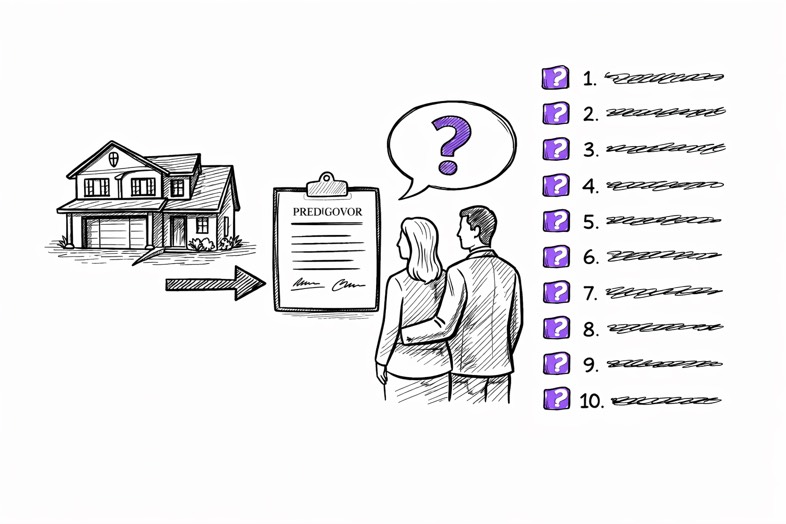
In Croatian legal practice, pre-prepared “template” preliminary contracts are often encountered that do not take into account all the specific features of an individual legal relationship, i.e. a particular sale and purchase transaction.
Therefore, below is an explanation of 10 questions that are considered relevant in practice before and at the time of concluding a preliminary contract.
IMPORTANT NOTE: all texts published on lucija.legal – although written by an attorney with many years of experience – are written in clear, plain, and conversational language. Legal terminology has been deliberately omitted to make the content easier to understand, and certain legal concepts are described in a highly simplified manner, while preserving their meaning. All texts and examples are provided for educational and public information purposes only. No text contains individualized or specific legal advice. For the resolution of particular legal issues, consulting your attorney is expressly recommended.
1. Is the person with whom the preliminary contract is being concluded registered as the owner in the land registry?
It is not irrelevant whether the “company that is selling” is stated in the preliminary contract, while the land register entry lists the director of that company or someone else entirely.
A real estate preliminary sale contract is — as a rule — concluded with the person (the seller) who is registered as the owner in the land registry.
2. Are there any co-owners of the property or spouses who would also need to sign the preliminary contract in Croatia?
If the seller owns only 1/3 of the apartment being sold, in such situations it is generally customary for all co-owners to sign the preliminary contract.
It is possible that it would not be sufficient for only one co-owner to sign.
Also — experience shows that in practice the issue of so-called “invisible” or “unregistered” owners is often considered.
For example — it is not uncommon for a court dispute to arise much later because the apartment is marital property, while the wife is not registered as an owner. This can lead to a subsequent court proceeding to establish marital property rights. …
3. Are there any active encumbrances, notes, pre-registrations, burdens, or other entries on the property in the land registry?
As a rule, in practice special and detailed attention is given to answering the following question:
Is the land registry status in order?
In other words — as people often say colloquially — are the “papers clean”?
In any case, for the sale and purchase process to proceed smoothly, the land registry status should be in order — both at the time of concluding the preliminary real estate sale contract and at the time of concluding the final real estate sale contract.
For this reason, the contracting parties often consult a qualified professional in advance to verify the status.
4. Is the preliminary contract of sale of the property being concluded in written form and notarised?
For a real estate sale contract to be valid, it must be in written form and include the seller’s notarized signature (notarial certification).
Accordingly, for a preliminary contract to be valid, it must also be in written form and contain the seller’s notarized signature.
This follows from the statutory provision which states:
“The formal requirements prescribed for the main contract also apply to a preliminary contract if the prescribed form is a condition of the contract’s validity.“
5. Does the preliminary contract contain an accurate description of the real estate?
If the property has been completed, the preliminary contract should, as a rule, contain a precise description of the property.
There is a specific method for accurately describing a property, which can be verified with a qualified professional.
This is not insignificant, as it may have legal consequences.
For example, it may happen that the land registry court refuses to register or implement a preliminary contract/contract in which the property is not properly described.
On the other hand, if the property is under construction, preliminary contracts should — as a rule — contain as much information about the property as possible, so that it can later be clearly identified.
For example, if it concerns an apartment under construction, preliminary contracts should in practice include data on — the land on which the building is being constructed, the building permit, the name of the investor, the project documentation, the apartment’s surface area and position according to the project, etc.
I have already written about the risks of buying an apartment under construction here.
6. Does the preliminary contract include a fixed or determinable purchase price?
In addition to precisely stated information about the contracting parties and the property being purchased, the preliminary contract must also contain a determined or determinable purchase price in order to be valid.
The preliminary contract does not have to specify the methods and deadlines for payment of that price (this will be defined later in the main contract).
However, it is not a bad idea for these elements to be included in the preliminary contract as well — so that the contracting parties can set their expectations.
7. Is there a set deadline for concluding the main contract?
This is a very important clause in preliminary contracts — and a frequent source of later disputes, disagreements, and problems.
Namely, the main purpose of concluding a preliminary contract is not the performance of the obligation itself (the real estate sale).
The main purpose of a preliminary contract is only the conclusion of the main sale and purchase contract.
This means that, according to the law, the preliminary contract must state the deadline by which the main contract will be concluded.
Once the main contract is concluded — the purpose of the preliminary contract has been fulfilled.
Problems often arise when the parties do not agree on the timeframe within which the main contract is expected to be concluded.
Construction projects are a typical example — especially where an occupancy permit is pending and both the issuance and timing are uncertain.
Nevertheless, regardless of the above — the preliminary contract should, as a rule, include some clearly defined time limit (e.g. six months from the date of conclusion of the preliminary contract, no later than June 1, 2027, or similar).
It is usually easy for the parties to agree later (if there is mutual willingness) to extend that deadline.
8. Is a deposit (“kapara”) agreed upon, and if so, what is the amount?
Provisions on “kapara” are common in preliminary contracts.
However — this is also an issue that requires additional attention in practice.
Namely, it is not irrelevant which term is used.
In other words — whether the contract refers to “kapara”, “kapara kao odustatnina”, “avans”, “depozit”, “predujam”, or something else.
Although these terms may appear similar to persons without legal training — each of them carries its own “weight” and is governed by specific legal rules.
It is also not insignificant what amount is requested in the name of “kapara”.
However, I have already written about situations in which particular caution is required when paying “kapara” here.
9. Does the preliminary contract include “exit” clauses?
In practice, the question is often raised — does the preliminary contract provide for situations in which the contracting parties may withdraw or cancel?
And in which cases is “kapara” returned, and in which cases is it not?
This clause also often has significant consequences.
Namely, it may happen that certain assumptions/conditions/benefits that one contracting party reasonably expected (for example, an access road) are ultimately not fulfilled, while at the same time there is a signed preliminary contract that provides for an obligation for that party to conclude the main contract regardless of that deficiency (e.g. lack of an access road).
In such a situation, the contracting party may find itself facing an uncomfortable choice:
- either not to conclude the main contract and lose the amount paid in the name of “kapara” or “predujam”,
- or to conclude the contract under circumstances that were not originally expected.
For this reason, in practice it is common to clearly regulate already at the preliminary contract stage the circumstances in which termination or cancellation of the preliminary contract is possible.
It is also important to note that — if one contracting party receives a pre-prepared “template” preliminary contract — it is common practice for the parties to try to negotiate its provisions and adapt them to the specific case.
As a rule, sellers and/or buyers who want to regulate the sale relationship clearly and transparently understand the other party’s need to be adequately protected by the contract.
10. How does the seller react and conduct themselves regarding the conclusion of the preliminary contract in Croatia?
Although this part is not directly related to law — experience shows that the behavior of the seller and/or buyer in relation to the conclusion of a preliminary contract is a highly indicative factor and is often taken into account (in a broader context).
Namely, the conduct of the contracting parties can also have a certain informational value.
If the signing of the preliminary contract is approached with caution, with an understanding for both parties’ positions and the need for mutual protection, and neither party reacts defensively to the suggestion of involving attorneys or similar — it is possible that the later sale process will also proceed quickly and smoothly.
On the other hand, if the conclusion of the preliminary contract is delayed, prolonged, or proposed amendments are treated by one or both parties as “unnecessary hassle”, etc. — caution is advisable.
If, as an owner (or future owner) of real estate, you are seeking more detailed legal support in property-law and business matters — you can find more information about cooperation options here.