Buying an apartment “on paper” has become the rule in Croatia, not the exception.
Demand exceeds supply, new developments sell out before the foundations are even excavated, and buyers sign pre-contracts for properties that exist only as 3D renderings.
In this race, one fact is systematically overlooked: the buyer of an apartment under construction is not a buyer — he is a creditor.
For months or years, he finances someone else’s construction project, and in return receives – more or less – a promise.
The quality of that promise is very often not apparent at first glance – it depends on numerous nuances of a factual and legal nature which – unfortunately – are overlooked in the very early stages of a construction project because the buyer believes it to be an “excellent opportunity”.
Questions only begin to arise once problems start to surface – first and foremost delays, but also inadequate communication, poor documentation, unclear financial standing of the developer, and so on.
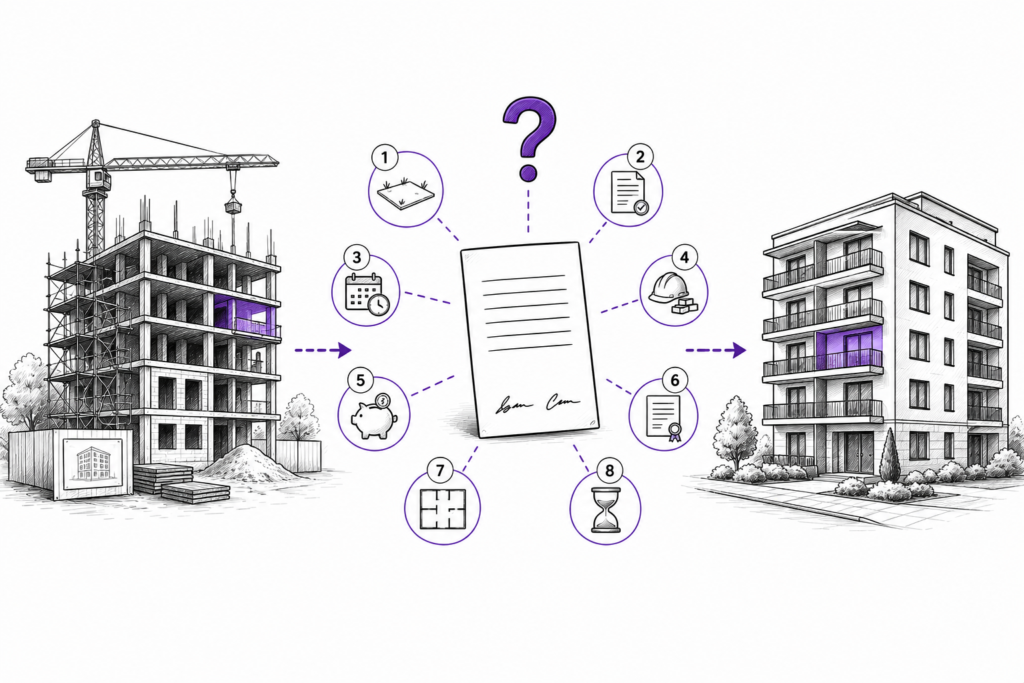
Below — eight serious risks that very frequently materialise in practice, described as they really happen.
1. The Pre-contract arrives as a ready-made template – "take it or leave it"
The first risk is one the buyer most often voluntarily assumes before ever seeing the construction site.
A finished, standardised pre-contract is placed on the table. The same text is signed by all “buyers” of apartments in the building – that is the explanation given by the sales representative.
He adds that the “pre-contract is standard”, that it was “drafted by a lawyer” and that “amendments are unfortunately not possible because all buyers sign the same text“.
The problem, however, is not standardisation as such — the problem is that it is (very often) drafted exclusively in the developer’s interest.
The developer’s pre-contract is written by the developer’s lawyer, and every clause on deadlines, deviations, sanctions and termination is, as a rule, carefully worded so as to “circumvent” the question of liability.
A typical scenario from practice in Croatia: the pre-contract contains a provision under which default interest accrues from day one for any delay by the buyer in paying an instalment — while the developer bears no consequence whatsoever for a six-month delay in handover, because the completion deadline is defined as “indicative” or “planned”. Or the handover itself is vaguely defined.
When the buyer raises this, the response is that there is a waiting list of reservations behind him and that someone else can buy the apartment. At that moment, most buyers sign — because the market leaves no room for negotiation.
Nowhere is the asymmetry of bargaining power more visible than here.
It follows that in a transaction worth several hundred thousand euros, the buyer has less room to negotiate than when buying a used car.
2. The developer is not even registered as the owner of the land
It sounds unbelievable, but it happens regularly in Croatia: pre-contracts are signed, deposits are paid — yet the developer is not registered at all in the land registry as the owner of the parcel on which the building is being constructed.
The owner is a third party: a natural person from whom the developer has yet to purchase the land, a family member of the founder, a related company, or a person who will be entitled to one of the completed apartments (very often on the basis of a partnership agreement).
However – legal logic is relentless, and the ancient Romans already said it: no one can transfer more rights to another than he himself holds.
A developer who is not the owner cannot validly transfer to the buyer ownership of a separate unit, or any other right in or in connection with the property — regardless of the fact that the buyer has duly paid every instalment.
In other words – the entire chain of future registrations depends on a single fact over which the buyer has no influence whatsoever and of which – very often – he knows nothing at all.
A possible scenario:
the buyer pays instalments for two years according to the schedule set out in the pre-contract. The building is completed, occupied, the neighbours are renovating. And then — upon attempting registration of title — it comes to light that the developer bought the land from a seller with whom he has since ended up in a dispute over payment, that the transfer of ownership to the developer was never registered, and that a notice of dispute has meanwhile been recorded against the property. The buyer lives in an apartment which, in land registry terms, does not exist and which he can neither sell, nor mortgage to secure a loan, nor pass on by inheritance without complications. Such a situation can persist for years.
A particular variant of the same problem: the developer is not the owner, but the holder of a right to build (pravo građenja). That is, legally speaking, a valid basis for construction — but the right to build is limited in time and is encumbered by everything that encumbers ownership itself, and this distinction is, as a rule, never explained to the buyer during the sales conversation.
3. The bank's mortgage over the entire property
As a rule – virtually no new development in Croatia is financed exclusively with the developer’s own funds.
The standard model: a bank finances the construction and, as security, registers a mortgage — not over the individual future apartments, but over the entire property.
In other words: over the parcel, the building under construction and all of its future separate units.
This means that the buyer paying instalments for “his” apartment is in fact paying off a property which serves as collateral for someone else’s (the developer’s) debt.
The buyer’s payments go to the developer; while the bank holds its claim secured over everything — including the apartment the buyer may already have paid for in full.
As long as everything goes according to plan, the system functions: the developer repays the loan out of the purchase prices, upon each payment the bank issues deletion statements (brisovna očitovanja) for individual apartments, and the mortgage “melts away” apartment by apartment.
The problem arises when the plan collapses.
A typical scenario:
the buyer has paid the full price and moved in. The developer, however, has diverted the sale proceeds into the next project instead of repaying the loan — or into covering losses on the previous one. The bank, not having received what it is owed, moves to collect its claim and initiates enforcement proceedings against the property (which encompasses the entire building). Very often – it is only then that the buyer discovers or becomes aware of what had been recorded in the land registry all along, without anyone ever explaining to him what it meant: his “apartment” is collateral for a debt that is not his. In the worst outcome, he finds himself defending a property he has paid for in full in enforcement proceedings initiated by the bank — against which, as a third party, he has very limited remedies.
The most dangerous aspect of this risk is that it can be entirely invisible in the sales process, unless you duly and regularly check the state of the land registry. The showroom is immaculate, the renderings gleam, the sale price includes VAT — while an encumbrance of several million euros sits quietly in Sheet C of the land registry.
4. The developer is a single-euro company (j.d.o.o.) with no assets and no "business history"
A glance at the Croatian court register reveals that the developer of a grand thirty-apartment project is — a simple limited liability company (j.d.o.o.) with share capital of one euro, incorporated eight months ago, with no employees, no business history, no assets.
Or a “classic” d.o.o., but incorporated exclusively for a single project: a so-called special purpose vehicle (SPV).
The model itself is not unlawful — separating projects into distinct companies is a legitimate risk management technique.
The only question is whose risk is being managed.
The answer: the developer’s.
Limited liability means that only the company is liable for its obligations, with its own assets.
And when the company’s assets consist of one euro of share capital and a mortgaged construction site, the developer’s “liability” towards the buyers is, mathematically — zero.
Behind the project company there often stands a group with a serious name and a portfolio of completed buildings, which is used abundantly in the marketing.
Legally, however, the buyer is not in a relationship with the group, but with that j.d.o.o.
The advertising slogan “fifteen years of experience and a thousand apartments built” is signed by the brand; the pre-contract is signed by a company eight months old.
A typical scenario:
the project stalls, and the buyers demand a refund of what they have paid. The project company has nothing — all the money has been “spent on construction”, the equipment is leased, the land is mortgaged. The parent company, the one whose name appears in the advertising, shrugs: it is not a party to the contract. Within a few months, the founders incorporate a new project company, for a new project, with a new single euro of capital. The buyers are left holding a claim against an empty shell — one that is legally impeccably structured.
5. No security is offered for the deposit paid
Under the Croatian Civil Obligations Act, the deposit (kapara) serves as evidence that a contract has been concluded and as an instrument reinforcing contractual discipline: if the party who received the deposit fails to perform the contract, the other party may demand the return of double the deposit.
On paper — strong protection.
In the reality of off-plan purchases, that protection rests on an assumption which is tacitly taken for granted and which no one verifies: that the developer will, when the moment comes, have the means to repay.
The right to double the deposit against an illiquid debtor is worth exactly as much as any other unrecoverable claim — nothing.
It is precisely for this reason that it is telling that developers, for the deposits they receive — which at today’s prices regularly amount to 10% of the purchase price, i.e. tens of thousands of euros — as a rule offer no security instrument whatsoever.
No bank guarantee, no zadužnica, no insurance of the payment with an insurer.
The buyer pays, and in return receives the signature of the company described in the previous section.
A typical scenario:
the buyer pays a deposit of EUR 35,000 for an apartment whose construction is “about to begin”. The start is postponed — problems with the permit, then with the contractor, then with the “administration”. After a year and a half, the buyer wants out of the deal and demands the return of double the deposit, as the law entitles him to do. The developer disputes nothing — he simply does not pay. What follows is a lawsuit, years of litigation, a final and binding judgment… and enforcement against a company with nothing in its account. Legally, the buyer has been in the right from day one. Economically, he has lost EUR 35,000 and five years.
6. The deposit and instalments are paid directly into the developer's account
This risk builds on the previous one, but it is systemic — and therefore deserves its own heading.
In some European countries, the sale of apartments under construction is subject to specific statutory regulation: the buyer’s payments go into a dedicated (escrow/fiduciary) account, are released to the developer in stages of construction certified by supervising engineers, and the buyer is protected even in the event of the project’s collapse.
In Croatia — as the legislation stands at the time of writing — no such general protective system for purchases from private developers exists.
Special rules on deposits and down payments exist for public housing construction programmes, but a typical market-rate new development proceeds under the regime of general freedom of contract.
In practice this means: the deposit and all instalments are paid directly into the developer’s ordinary business account, where they merge with the company’s other funds, and the developer disposes of them entirely freely.
Nothing prevents him from using the payments of the buyers in building A to finance the purchase of land for building B, to repay old debts or to cover current losses. The buyer’s money ceases to be the buyer’s the second it is paid — while the apartment it was paid for exists only at foundation level.
A typical scenario:
construction of the building visibly slows down, then stops. The buyers, who have collectively paid several million euros, learn that the developer used their money to “bridge” problems on another construction site — which has also come to a halt. The money has been spent, and both buildings are concrete skeletons. And yet no one has committed any obvious criminal offence: the money was spent on the “company’s business operations”. The buyers have, without knowing it, financed the developer’s entire business system — with no interest, no security and no say.
7. The as-built state deviates from the building permit
A building is constructed in accordance with the main design and the building permit.
Between the permit and the as-built state, however, a gap can open up: an extra floor, a converted attic, enclosed loggias that increase the “saleable” floor area, shifted building dimensions, a changed number of apartments.
Sometimes these are minor matters remedied by an amendment to the permit — sometimes they are deviations that cannot be remedied at all.
The consequence strikes at the point on which everything else depends: the occupancy permit (uporabna dozvola).
A building constructed contrary to its building permit cannot obtain one until the deviations are removed or legalised — if that is possible at all.
And without it, the apartment is formally not lawfully usable: banks in Croatia as a rule do not approve mortgage loans for the purchase of such apartments, connections to utility infrastructure are impeded, condominium division (etažiranje) and registration of separate units stall, and the property’s resale value drops considerably.
The buyer, moreover, can almost never detect the deviation himself — he sees the building, not the design.
He learns of the problem indirectly: the handover is postponed “due to the technical inspection”, then postponed again, and then the developer begins offering handover “against a handover protocol, with the permit arriving shortly”.
A typical scenario:
the buyers move into the completed building on the basis of handover protocols, pay everything down to the last euro, and fit out their apartments. The occupancy permit (uporabna dozvola) is “arriving shortly” — for years. It turns out that the building has one floor more than the permit allows and that legalisation depends on an amendment to the spatial plan, over which neither the developer nor the buyers have any influence. The apartments are occupied, the children attend the nearby school, life goes on — but the properties are legally unfinished, unusable as loan collateral and devalued on the market. The buyers are left with protracted litigation against a developer which, very often, has in the meantime become the company from section 4 — an empty one.
8. The developer's insolvency or account blockade mid-construction
The final risk is a cumulative one — the scenario in which all of the preceding risks materialise at once.
The construction sector operates on high leverage: with other people’s money (the bank’s and the buyers’), on thin margins sensitive to material prices, interest rates and the pace of sales.
When several variables shift for the worse at the same time, the developer first ends up with a blocked bank account — and a blockade that persists leads to pre-insolvency or insolvency proceedings.
For a buyer holding a pre-contract, the developer’s insolvency means the following: his claim for delivery of the apartment, or for the refund of what he has paid, becomes an insolvency claim which must be filed against the insolvency estate within a preclusive time limit.
Within that same insolvency estate, the buyer stands as an ordinary, unsecured creditor — behind the bank, whose claim is secured by the mortgage (a right to separate satisfaction) and which is settled out of the value of the property before anyone else. Only what (possibly) remains is distributed among the other creditors: suppliers, contractors, the State — and the buyers.
The arithmetic is devastating.
A mortgaged property in insolvency proceedings is as a rule sold below market value, the bank takes the lion’s share, and the recovery rate for ordinary creditors in Croatian insolvencies is notoriously low — often in the single digits, not infrequently zero.
A typical scenario:
the buyers of a building completed up to the third floor arrive one morning to find the construction site deserted. The developer’s accounts have been blocked for months — something each of them could have discovered with a simple SMS enquiry to FINA on account blockades, but no one checked after signing the pre-contract. Insolvency proceedings are opened.
The buyers, each of whom has paid 60–80% of the price, file their claims and wait.
From the sale of the unfinished building, the bank recovers part of its loan. For the buyers — who collectively invested more in the project than all the other creditors combined — a symbolic percentage remains, or nothing at all.
With no security instruments, no registration in the land registry, no segregated account for their payments, they were the entire time exactly what this text has claimed from its very first sentence: unsecured creditors of someone else’s business venture.
Instead of a conclusion - a call for heightened caution
None of the eight risks described here is exotic.
Each of them materialises, every year, on the Croatian real estate market — and the common denominator of them all is that they are visible before the pre-contract is signed: in the land registry, the court register, the financial statements and the very text of the contract.
Buyers fail to see them not because they are hidden, but because no one has taught them where to look — and because the sales process of a new development, with its attractive 3D renderings, actively discourages looking.
However – if, before signing the (pre-)contract, a person is prepared to put to the developer (and to themselves) certain – possibly uncomfortable – questions, many of the risks described here can perhaps be excluded or at least minimised.