Skip to content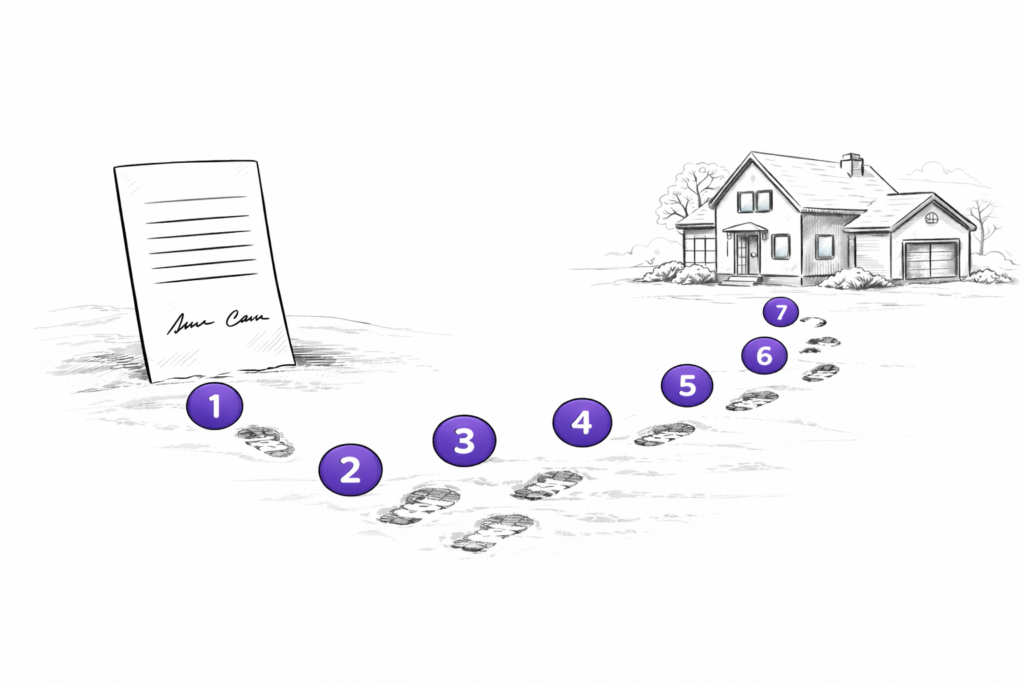
In real estate transactions, absolute legal certainty is an unattainable ideal.
Especially considering that certain legal or material defects on a property may appear only months (or years) later.
Nevertheless, there are steps that allow a buyer to achieve a higher level of protection.
Namely, details that may seem “self-evident” to a buyer (as a legal layperson) can later make the difference between a successful investment and a years-long legal dispute.
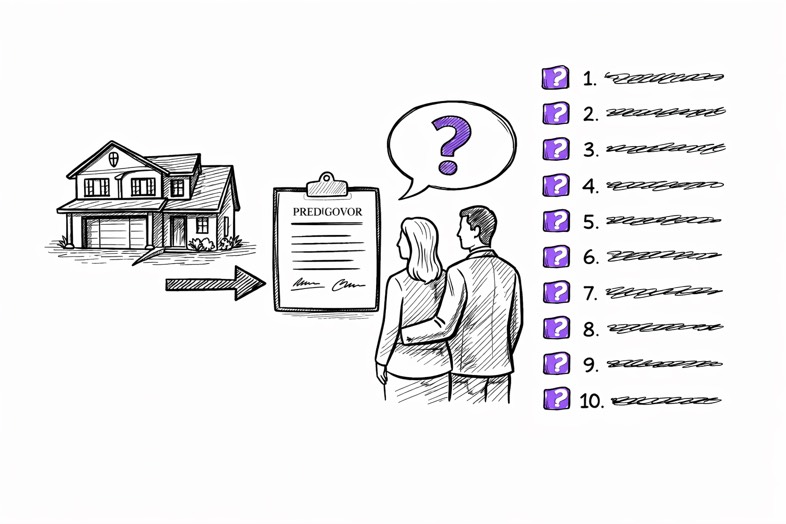
In this analysis, we will reflect on seven steps in the real estate purchase process in Croatia that, throughout years of legal practice, have proven effective in achieving more efficient legal protection for the buyer.
In the following:
- 1. Why is a thorough verification of the property’s legal status important?
- 2. Pre-contract for the sale of real estate – when is it redundant, and when is it necessary?
- 3. Real estate purchase agreement – the legal basis without which a sale is generally not possible
- 4. When is a pre-notation of the purchase agreement in the land registry required and what is its purpose?
- 5. Tabular statement – the “queen of changes”
- 6. Registration of ownership rights – why it is the goal the buyer strives for
- 7. When is the “real estate purchase tax” or real estate transfer tax paid?
- Why is absolute legal certainty not attainable?
IMPORTANT NOTE: all texts published on lucija.legal – although written by a lawyer with many years of experience – are written in simple, conversational language. Legal terminology has been intentionally omitted for easier understanding, and certain legal concepts are explained in a highly simplified manner – while still preserving their actual meaning. All texts and examples are provided solely for educational purposes and for informing the public. None of the texts contain individualized or specific legal advice. For resolving concrete legal matters – including issues related to buying real estate in Croatia – you are expressly advised to consult with your lawyer.
1. Why is a thorough verification of the property's legal status important?
A thorough verification of the legal status of the real estate is essential, as practice shows that details can make the difference between an ideal desired outcome and a legal dispute.
Therefore, before any payment is made, it is justified to more than once check all available information about the real estate.
Primarily, the land registry entry.
Namely, the current land registry entry reveals who the owner is, whether there are active motions (plombe), recorded disputes, or encumbrances (mortgages). But it may also contain much other information.
Then – the historical extract.
Namely, insight into the history of ownership/disputes/encumbrances/motions can point to “hidden facts or issues” that could affect the future owner.
In the same context, the possession list is also important, since the situation in the cadastre should be aligned with the state of the land registry.
Note from legal practice: the state of the land registry is checked again on the very day of signing the purchase or other agreement in order to eliminate the risk of fraudulent conduct at the last moment.
In addition to the legal status, it is advisable to check „life facts“.
For example – it is unpleasant if a buyer subsequently finds out that no one lives in the apartment next to the one purchased and it is not maintained.
Or that there is a bell tower nearby that rings 30 times a day.
Or that the elevator in the building breaks down twice a week.
Or that a nearby café is a gathering place for fans.
And so on and so forth … because life is an inexhaustible source of inspiration.
Furthermore, in practice, it proves useful to request from the current owner all other possible documents relating to the real estate, past or present (energy certificates, proof of utility payments, etc.).
Additionally – it proves useful to inquire about the amount of building reserve funds (pričuva) or monument rents, or other costs – which might be unexpected or unseen at the moment of purchase.
In any case, verifying the identity of the seller – whether it is a natural person or a company – is crucial for assessing their future willingness to cooperate if problems arise.
Namely, certain types of problems are most easily resolved peacefully and together.
2. Pre-contract for the sale of real estate - when is it redundant, and when is it necessary?
If it is possible for the buyer to become the owner immediately – a pre-contract for the purchase of real estate may not be necessary.
However, a pre-contract is generally unavoidable when buying apartments under construction.
Or when the completion of the purchase is postponed to the future for certain reasons.
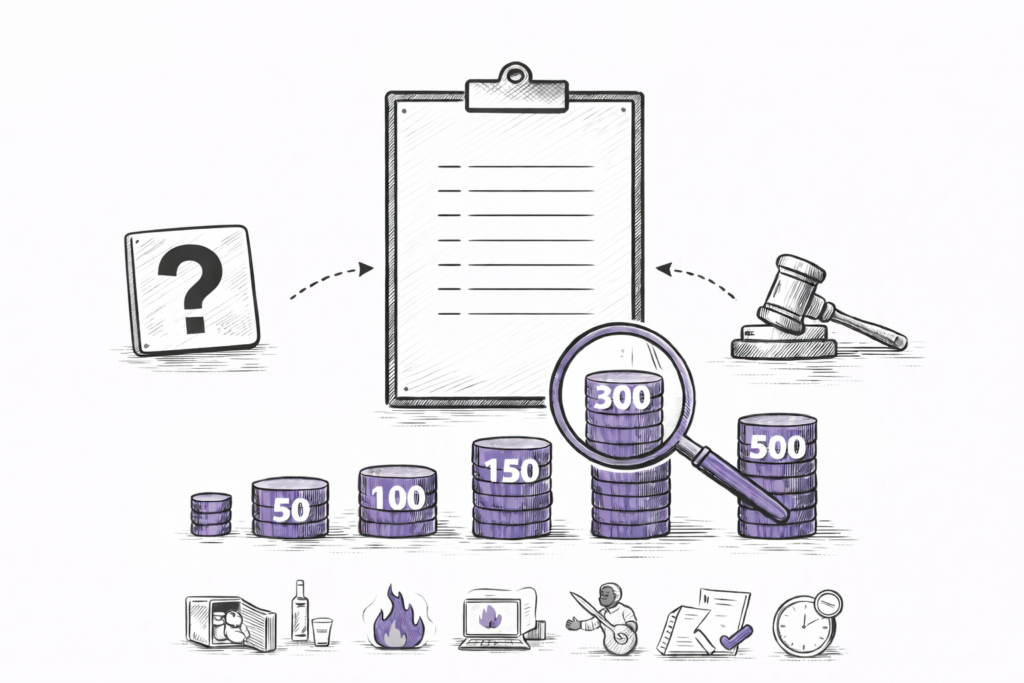
Namely, the pre-contract determines the deadline for concluding the main contract and its essential elements (price, down payment, cancellation fee).
In addition to the deadline, in practice, it proves useful to include provisions in the pre-contract that protect the buyer.
What kind of provisions are these?
Among others – provisions that will establish the buyer’s right:
- to terminate the pre-contract;
- to exercise the right to a refund of the down payment
For example, the right to termination for the reason that at the moment when the real estate purchase agreement is being concluded, the land registry status is not in order.
What does this mean in practice?
Explained by an example: there is a possibility that the seller, from the day of concluding the pre-contract until the day of concluding the main contract (which usually involves months), encumbers the real estate with a loan.
The buyer can then find themselves in a situation where if they do not sign the main contract – they lose the down payment because they “backed out”, and if they do sign – they will become the owner of a credit-encumbered real estate.
For exactly this reason – it is considered risky without a legal check to sign pre-contract templates proposed by the seller.
On the other hand, if provisions that also protect the buyer are included in the pre-contract – such unwanted developments can be avoided.
3. Real estate purchase agreement - the legal basis without which a sale is generally not possible
A real estate purchase agreement must be concluded in writing, and the seller’s signature must be notarized by a public notary.
If a bank is also involved, in practice, the agreement will very often need to be solemnized as well.
A real estate purchase agreement may contain a tabular statement, but it does not necessarily have to.
From legal practice, however, it appears that the sale proceeds more securely for both parties — if the tabular statement is not included.
In any case, provisions are included in the real estate purchase agreement that determine under what conditions and how the buyer will obtain the tabular statement.
Important note — caution during the notarization of the agreement by a public notary:
A public notary in the Republic of Croatia, by official duty (by law), automatically sends the agreement to the court for registration in the land registry via the electronic service e-nekretnine. If the tabular statement is within the agreement, in certain cases, the buyer could become the registered owner within a day or two, even if all other agreed conditions (such as payment) have not been met. Therefore, to protect the seller — it is important to emphasize to the public notary that they object to sending the agreement for registration until the contractual provisions are fulfilled.
4. When is a pre-notation of the purchase agreement in the land registry required and what is its purpose?
Once the purchase agreement is notarized, but it does not contain a tabular statement — the buyer can pre-note their ownership in the land registry.
In practice, the proposal for the pre-notation of ownership rights should be sent to the court as soon as possible, ideally on the same day — immediately after signing.
Why?
Because the pre-notation of ownership rights is, as a rule, in the interest of every buyer — as it preserves the buyer’s priority rank.
What is priority rank?
The priority rank of entry is a legal institute which determines that, when registering changes in the land registry, all incoming proposals — are recorded in the order in which they were received.
In other words — the one who submitted the proposal earlier — will generally be registered first (provided the legal conditions for said registration are met).
For example — if the buyer does not submit the proposal for the pre-notation of the real estate purchase agreement on the same day — and tomorrow the seller (with fraudulent intent) concludes a purchase agreement for the same real estate with someone else, and that other buyer submits a proposal before the first buyer — it is possible that the first buyer will no longer be able to register as the owner. At least not without a prior legal dispute.
In that case, a simple transaction that was supposed to be a sale — becomes a legal dispute that could potentially last for months, and without a certain outcome.
In other words, in practice, the recommendation is to carry out the pre-notation of ownership rights.
How long does the agreement remain pre-noted?
The purchase agreement usually remains pre-noted until the buyer obtains the tabular statement.
Once obtained — they will submit it to the land registry court as well, and the court will register the buyer as the owner (if all other conditions are met).
5. Tabular statement - the "queen of changes"
In legal practice — as the best example for resolving the question — “who goes first?” (the buyer providing the money to the seller, or the seller providing the ownership to the buyer) the following method has proven very effective.
The tabular statement is notarized on the same day as the real estate purchase agreement, but it is stored (“kept”) with the public notary.
The purchase agreement specifies that the tabular statement is “in the custody” of the public notary — until, for example — the buyer presents to the public notary a bank confirmation that the funds have been deposited into the seller’s account.
Upon receiving said confirmation, the public notary issues the tabular statement to the buyer.
6. Registration of ownership rights - why it is the goal the buyer strives for
A real estate purchase ideally concludes with the registration of the buyer’s ownership rights and the payment of funds to the seller.
However — what does the registration of ownership rights mean?
The registration of ownership rights means that in the land registry entry (which can be found independently online), it is visible in Schedule B (vlastovnica) that the buyer’s first and last name, PIN (OIB), and address are recorded.
In the previously described case — for the buyer to be registered as the owner (where a pre-notation is already recorded) — it is generally sufficient to simply submit the tabular statement to the land registry court to justify the pre-notation.
How long does the process of registering ownership rights in the land registry take?
Practice shows that this varies among courts.
Namely, it will generally depend on the number of clerks processing the entries, the volume of incoming cases, and sometimes even the season (in summer — when everyone is on vacation — it goes much slower).
However, since all proposals to the court are submitted electronically, the resolution is much faster.
In the context of the aforementioned — one might ask — but what if someone else submits a proposal after me, and the land registry court has not yet resolved mine? Does that matter?
It should not.
Namely, on the same day the land registry court receives a proposal, it will record it on the land registry entry as an active motion (plomba) (a case pending resolution).
If someone else subsequently submits another proposal, it will also receive an active motion, but one that follows the first in order. Therefore, the court will resolve the proposals according to the priority rank.
7. When is the "real estate purchase tax" or real estate transfer tax paid?
The acquisition of real estate, as a rule, entails a tax liability about which it is useful to inform oneself in detail through analyses of tax exemptions, calculations, and payment methods, in order to avoid unpleasant surprises. More on this issue here
Why is absolute legal certainty not attainable?
Even a proper registration does not entirely eliminate the risk of lawsuits due to the existence of, for example, marital property that is not visible in the land registry or the challenging of legal actions by third parties.
Precisely because of the inexhaustible diversity of life situations, maximum caution and professional analysis of documentation preparation are the only tools to minimize risks.
If you are a foreigner looking for comprehensive legal support with real estate and business matters in Croatia, you can find more information about collaboration opportunities here.